Stretched Metal Mesh
Stretched metal mesh sits at a fascinating point where engineering logic meets visual design. A flat metal sheet becomes lighter, more breathable, and often more useful once it is slit and expanded, which is why the material keeps showing up in factories, transport projects, retail interiors, and contemporary facades. Its importance is not just aesthetic; it can improve airflow, support safety, and reduce dead weight while staying tough enough for demanding environments. This article follows that journey from material basics to practical applications and informed specification.
Outline: first, the article explains what stretched metal mesh is and how its manufacturing method shapes performance. It then moves through architectural uses, industrial and infrastructure roles, life-cycle benefits, and a final selection guide aimed at designers, engineers, fabricators, contractors, and facility managers who need reliable, workable decisions.
1. Understanding Stretched Metal Mesh and the Logic Behind Its Performance
Stretched metal mesh, often referred to in industry discussions as expanded metal mesh, is made by slitting a metal sheet and stretching it into a repeating pattern of openings. That detail matters more than it may seem at first glance. Because the material is formed from one continuous sheet rather than assembled from many wires or bars, it keeps structural continuity across the panel. There are no weld points to fail in the middle of the pattern and no woven strands that can shift out of place after cutting. In practical terms, that gives stretched metal mesh a distinct mix of strength, openness, and dimensional stability.
The shape of the openings can vary, but diamond patterns are the most familiar. Manufacturers also produce square, elongated, and decorative geometries depending on whether the project prioritizes grip, visibility, shading, security, or appearance. The metal itself may be carbon steel, galvanized steel, stainless steel, aluminum, copper, or specialty alloys. Each choice changes the balance between weight, corrosion resistance, formability, and cost. Aluminum is valued when low weight matters. Stainless steel is commonly chosen for corrosive or hygiene-sensitive environments. Mild steel remains popular for general-purpose industrial work because it combines affordability with dependable mechanical performance.
Raised and flattened forms add another layer of distinction. Raised mesh keeps the ridges created during expansion, which can increase slip resistance and is useful for walkways or ramps. Flattened mesh is passed through rollers to create a smoother surface, making it easier to use in facades, infill panels, and architectural screens where a cleaner visual plane is preferred.
Compared with alternatives, the differences become even clearer:
• Woven wire mesh offers precision and fine openings, but it can fray or deform differently under load.
• Welded wire mesh provides regular spacing, yet its joints become critical stress points.
• Perforated sheet gives neat holes and crisp geometry, though it often removes more material without producing the same stiffening effect.
• Solid plate blocks sight, air, and light entirely, which is useful in some cases but limiting in many others.
Another practical advantage is open area. Depending on strand width, thickness, and pattern size, stretched metal mesh can provide a substantial percentage of open space while still maintaining useful rigidity. That balance explains its broad appeal. It is not simply metal with holes. It is a geometry-driven material whose properties emerge from the way the sheet is transformed. Once that is understood, its many applications make much more sense.
2. Architectural and Interior Applications: Where Utility Becomes Visual Language
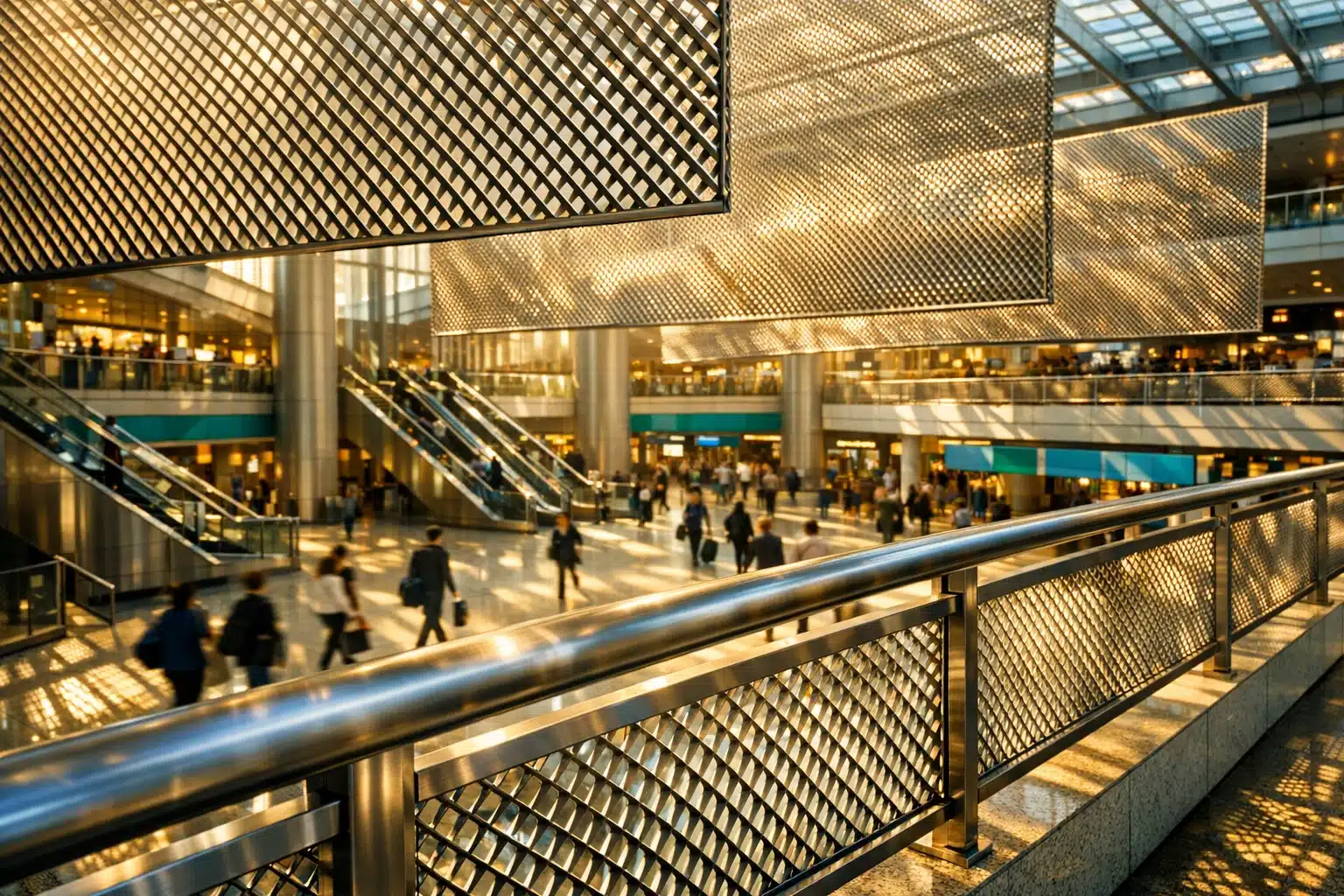
In architecture, stretched metal mesh is one of those rare materials that can solve technical problems while also giving a building a stronger identity. It appears in facade screens, parking structure cladding, stair enclosures, guard infills, suspended ceilings, room dividers, sunshades, and retail displays. From a distance, it can look almost like woven fabric rendered in metal; up close, its geometry reveals a tougher personality. That dual character is a major reason designers keep returning to it.
Facade design is one of the clearest examples of its value. Buildings need ventilation, solar control, and service screening, but owners rarely want bulky add-ons that make the exterior feel heavy. Stretched metal mesh can wrap around a facade and soften the appearance of mechanical zones, parking decks, or exposed circulation routes while still allowing air movement. In hot climates, this becomes especially useful because screened exterior layers can help reduce direct solar gain on the primary envelope. While the exact thermal benefit depends on orientation, pattern density, and installation detail, the shading effect can meaningfully improve comfort and reduce glare.
Interior applications are just as compelling. In offices and hospitality settings, designers use flattened aluminum or stainless mesh for partitions that preserve openness while still marking boundaries. In stores, it can support shelving systems, display fixtures, or branded feature walls. In transit stations and public buildings, it is often chosen for balustrade infill and ceiling treatments because it is durable, tamper-resistant, and relatively easy to maintain compared with more fragile decorative finishes.
When compared with common alternatives, the benefits become specific rather than abstract:
• Glass looks sleek but is heavier, more fragile, and far less breathable.
• Timber screens can be warm and attractive, yet they generally demand more maintenance outdoors.
• Perforated panels provide a clean visual field, though they may not create the same sense of depth and transparency.
• Cable or wire systems feel lighter visually, but they do not always deliver the same robustness in high-traffic public areas.
Architects also like the flexibility of finish options. Powder coating can introduce color without hiding the pattern. Galvanizing supports durability in exposed conditions. Anodized aluminum works well where a refined metallic finish is desired. Lighting designers, meanwhile, appreciate how mesh interacts with illumination, casting layered shadows and creating a sense of depth that plain flat panels rarely achieve. In that sense, stretched metal mesh behaves like a high-performing building component and a design tool at the same time. It protects, filters, frames, and signals intention without shouting for attention.
3. Industrial, Safety, and Infrastructure Uses: Hardworking Roles in Demanding Settings
If architecture shows the elegant side of stretched metal mesh, industry reveals its stamina. This material is widely used for machine guards, safety enclosures, catwalks, maintenance platforms, stair treads, trailer ramps, storage partitions, fencing panels, equipment screens, and protective covers. In these settings, appearance matters less than reliability, but the same geometric logic that makes mesh visually interesting also makes it practical. Openings allow operators to see through barriers, air can circulate around equipment, and liquids or debris can pass instead of accumulating on the surface.
Raised stretched metal mesh is especially valuable for walking surfaces. The ridged profile can improve traction under boots and help shed water, mud, snow, or oil more effectively than some smoother sheet products. That is why it often appears on mezzanine floors, service walkways, loading platforms, and outdoor access routes. Bar grating may be preferred for very heavy structural loads, but stretched metal mesh can be a strong and economical choice where moderate loading, drainage, visibility, and lighter weight are all part of the equation.
Machine guarding is another important application. Safety systems need to prevent accidental contact with moving parts while still allowing inspection and ventilation. Solid barriers block sightlines and can trap heat. Transparent plastics scratch, age, or fail under certain conditions. Wire mesh may be adequate, yet expanded patterns formed from a single sheet can offer a robust alternative with fewer assembly points. Exact guard specifications depend on the machine, the hazard zone, and local regulations, but stretched mesh frequently fits well where visibility and toughness must coexist.
Infrastructure projects also make broad use of the material. It appears in bridge fencing, utility enclosures, public stairways, drainage covers, rail-side barriers, and parking structures. The reason is straightforward: public assets need surfaces that resist vandalism, require limited upkeep, and continue functioning in weather changes. Mesh panels, especially in galvanized or stainless finishes, can perform well over long service periods when properly detailed and maintained.
Typical industrial advantages include:
• Good airflow around motors, pumps, and enclosed equipment
• Clear sightlines for inspection and supervision
• Reduced surface water retention on platforms and walkways
• Durable, one-piece construction with minimal internal joints
• Adaptability to custom frames, cutouts, and fabricated assemblies
In many work environments, stretched metal mesh succeeds because it does not pretend to be delicate. It is a straightforward material that accepts rough use, supports safety goals, and integrates with standard fabrication methods. That combination makes it a dependable choice for plants, warehouses, transport systems, and municipal installations where performance has to show up every day, not just on the day of installation.
4. The Core Benefits: Strength-to-Weight Efficiency, Durability, Airflow, and Long-Term Value
The biggest reason stretched metal mesh has remained relevant across so many sectors is simple: it solves multiple design and performance problems at once. Instead of forcing specifiers to choose between strength and openness, or between durability and visual lightness, it offers a practical middle ground. The details vary by alloy, gauge, and pattern, but several benefits appear again and again in real projects.
First is strength-to-weight efficiency. Because the material is expanded rather than punched full of removed circular holes, it can gain stiffness through the geometry created during forming. That means a panel can feel more substantial than its mass suggests. This matters in transport, facade design, equipment guarding, and retrofit work where dead load affects handling, support frames, and installation cost. Aluminum versions are especially attractive in this respect because aluminum has roughly one-third the density of steel, allowing substantial weight savings where heavy-duty steel is not necessary.
Second is airflow and light transmission. Open area can range widely depending on the pattern, often from fairly modest percentages to very high levels. That flexibility allows designers to tune visibility, shading, and ventilation. A parking garage screen, for example, may need generous airflow and partial visual concealment. A stair infill may prioritize safety and appearance. A machine enclosure may require operator sightlines and heat dissipation. One material family can serve all of those goals with different specifications.
Third is durability. Since stretched metal mesh begins as a continuous sheet, it does not rely on a field of welded intersections in the same way some other mesh products do. Protective finishes further extend service life. Common approaches include:
• Hot-dip galvanizing for general outdoor corrosion resistance
• Powder coating for color, finish control, and additional surface protection
• Anodizing for aluminum components with a refined architectural look
• Stainless steel selection for marine, washdown, or corrosive environments
Fourth is maintenance and life-cycle value. A well-chosen mesh panel is relatively easy to inspect and clean because dirt is less likely to hide behind fully opaque surfaces. In exterior applications, the open geometry can reduce wind pressure and improve drainage compared with solid panels. In operational terms, less trapped water and better ventilation often translate into fewer secondary problems.
Finally, there is material efficiency. Expanded patterns make useful surface area from a single sheet without the waste profile associated with some manufacturing methods. Actual sustainability results depend on sourcing, alloy choice, coatings, transport distance, and end-of-life recovery, but metal mesh can fit neatly into projects that value recyclability and durable service. The short version is this: stretched metal mesh keeps earning its place because it is not just strong or attractive or breathable. It is all of those at once in a form that can be fabricated, finished, and maintained with relative ease.
5. Selection Guide and Final Takeaways for Designers, Engineers, Fabricators, and Facility Managers
Choosing the right stretched metal mesh is less about finding a universal “best” option and more about matching the pattern to the job. That process starts with a few direct questions. Will the mesh carry foot traffic or only act as a screen? Is visibility desirable, limited, or irrelevant? Will the panel live outdoors, indoors, or near corrosive chemicals? Does the project prioritize low weight, high security, refined appearance, or low upfront cost? Once those questions are answered honestly, the specification becomes far easier to narrow.
Material selection is the first major decision. Carbon steel works well for many general industrial uses, especially when protected by galvanizing or coating. Stainless steel is more expensive, yet often worth the premium in coastal, humid, food-processing, or washdown environments. Aluminum is ideal when reduced weight, corrosion resistance, and easier handling matter. Pattern choice comes next. Larger openings can improve airflow and reduce visual mass, but they may weaken privacy or alter guarding suitability. Smaller openings create a denser appearance and can better control access, though they may also reduce transparency and ventilation.
Surface profile matters too. Raised mesh is often favored for traction on stairs, platforms, and service routes. Flattened mesh is easier to frame, easier to clean in some cases, and usually preferred for cladding, partitions, and infill panels. Finish selection should be driven by environment and maintenance expectations rather than appearance alone. A beautiful finish that fails in the local climate is a short-lived victory.
A practical checklist helps avoid expensive mistakes:
• Confirm loading, span, and support conditions before choosing thickness and strand dimensions.
• Review local code requirements for guarding, access control, and public safety.
• Coordinate panel size with fabrication and transport limits.
• Consider edge treatments, framing, and attachment methods early in the design.
• Account for cleaning access, replacement strategy, and long-term maintenance.
For architects, stretched metal mesh offers a rare chance to add texture, transparency, and function in one move. For engineers, it provides a dependable material system that can be tuned for load, ventilation, and durability. For fabricators and contractors, it is adaptable, familiar, and compatible with a wide range of support frames and finishes. For facility managers, it can reduce maintenance headaches while still handling hard daily use.
The central takeaway is clear. Stretched metal mesh is not a niche decorative extra; it is a flexible, performance-driven material that rewards careful specification. When the pattern, alloy, finish, and installation details are aligned with the real conditions of the project, it can deliver safety, longevity, airflow, and visual clarity without unnecessary complexity. For anyone selecting materials under practical constraints, that is a combination worth serious attention.